
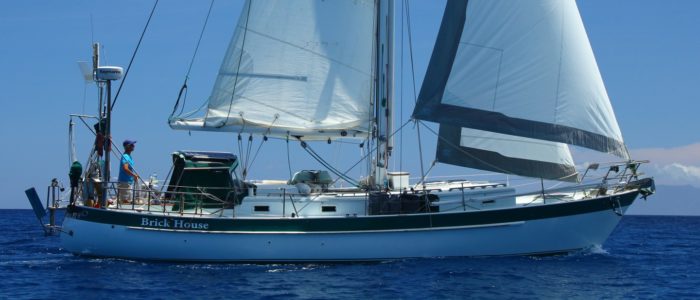
This is what appears in the October issue of Blue Water Sailing Magazine. We had no idea when we left Rhode Island that we would still be cruising after 10 years. Now, there really is no reason to quit so we are preparing for sailing off to the Indian Ocean in January, 2018. It looks like there will be many more What Worked, What Didn’ts, in the future.
After ten years of cruising, we aren’t going home any time soon. We are on our way across the Indian Ocean to South Africa; then; Tierra Del Fuego has an enticing tone. Along the way we are still finding some things that work and some that don’t.
LOFRANS TIGRES Windlass
After 10 years of countless anchorages on our way to half way around the world, our Lofrans Tigres windlass has been beat by tropical sun and continuous dousing of salt water. The only freshwater rinse it would get is from the rain. The Tigres has lost  some of its original cosmetic sparkle but none of its strength; this is despite at times winching up abandoned moorings or some other incredibly heavy thing off the ocean bottom along with our own ground tackle. And of course, there have been the impossible chain snags on rocks which pulled our bow down to the water and required SCUBA gear to untangle. With all the episodes of over-stressing, the only injury to the windlass was a widening of the “inner cone clutch” keyway. If the inner cone clutch can be removed without damaging it, then a machine shop can cut a new keyway opposite the worn one. This will suffice till a new cone clutch can be ordered.
The only maintenance I have done to the windlass is to occasionally apply a light coat of grease to the inner and outer clutch cones. As suggested by Imtra, lithium grease should be used for this lubrication although I have been using water repellent winch grease. Do not use automotive grease as it will attract salt residue and turn gummy.
There is a series of Tigres service videos at https://www.youtube.com/watch?v=daJBBSqcgNI
The only strange thing about the Lofrans is that you are supposed to change the gear oil every 4 years. To do so, however, you have to remove the whole windlass then turn it upside down to drain it. So, even changing the oil once in 9.5 years, as in my case, the Lofrans continues to work fine. When changing the oil, use a new gasket or “O”-ring under the oil screw plug to keep a good seal against water intrusion. When operating a windlass, be sure to run the electrical charging system to make sure the windlass is getting full amperage.
Manson Supreme Anchor

When we sailed away on Brick House for a world voyage, we kept the anchor chain on the CQR 60 pound anchor. On a very windy day in the Bahamas, anchored in 10 feet of water with 100 feet of chain out, the CQR plowed a long farmer’s furrow as it endlessly dragged across a grass bed nearly ending our voyage shortly after it began. Immediately we swapped the chain to our 65 pound Bruce. The Bruce was a big technological advancement over the CQR. Over a ten year period, the Bruce performed adequately except in 3 difficult situations, once in soft mud and twice in smooth coral. I always felt an anchor with a more pointy business end would not have slipped its hold in the way the Bruce did and would have given a more secure hold in more common anchoring textures.
Over the years, anchor technology has jumped over our Bruce anchor and we have followed the evolution. I have seen the adverts and touched the new anchor designs displayed on chandlery floors. There are several very good new anchor brands to choose from. Researching anchor tests and reading what Practical Sailor has to say about the Manson Supreme, we decided to make that our primary anchor and move the Bruce to the number two position. We anchor in far more varied conditions than what most anchors are tested in. I feel the Manson Supreme will be a big upgrade to our well used Bruce and should perform far better. However, if an anchor was made in China, I would not touch it. Manson anchors are made in New Zealand where we have witnessed the high caliber of yacht related manufacturing.
The one thing on the Manson Supreme I will not be using is the long slot to pull the anchor out of the sea bottom backwards. That is for day anchoring, not for a cruising boat that swings with changing currents or shifting winds.
Mack Sails

In Thailand, half way around the world from our sail maker in Stuart, Florida, we have ordered a new genoa to be made by Mack Sails. Some sailors in the U.S. think in the opposite direction as though it is a good idea to send their money to South East Asia to order a new sail.
In Thailand, we have had experiences with two sail lofts. One was a U.S. branded loft, in Jomtien Beach, Thailand, where we had them replace the light colored sun covering on our 6 year old Mack Sails. This was simple seamstress work. They did a nice job but the total bill was astoundingly exorbitant as though we were in a posh yachting haven of the Mediterranean. This is shocking when one considers the average Thai worker will make, more/less, $15 a day, if they are fortunate enough to find a job. It appears sail repair and sail making has taken on a world pricing regardless of the local economy. We won’t be using that sail loft again.
Since we are preparing to cross the Indian Ocean and potentially wander into the harsh, adventurous latitudes of deep South America, our attention turned to our mainsail. That sturdy sail was made in Whangarei, New Zealand, by David Parr, at Calibre Sails. The 8 year old sail had normal wear and an abused area which prudently needed attention. We took that sail to a very large, well known loft in Phuket, Thailand. When it was repaired and handed back to us, it was disappointing to find new webbing securing the sail slides was minimally stitched, unlike when we handed them the sail to repair. That attachment would not last a storm let alone an ocean crossing. There were other details which left an incomplete job. The loft was more than happy to correct these items but I had to think, what if we were not personally there to spot the defects before rolling it out on the deck of our floating home? What if this was done to a new sail and sent to us in the U.S.? It became apparent that if the workers on the floor, who’s hands put the sails together, have little experience sailing a boat, they will not understand the tremendous forces placed on a sail and will have a misguided sense of durability and construction technique. It does not matter if the upper management is European, there are too many details that cannot be micromanaged and will slip though the cracks. We were finding that to have sails made or repaired in Thailand may not be of the quality and pricing that advertisements suggest.
Googling for feedback on this Thai loft, seasonal coastal cruisers in the U.S. had favorable responses. When I queried our long range cruising friends, the consensus was very negative and that this brand of sail was not suitable for long term, offshore use. And with that, we chose not to follow a false economy but to order a US made Mack Sail which has proven endurance on Brick House. Our 6 year old sails, with some maintenance on the sun covers, are like brand new despite years of sitting in the sun, and being used in every kind of weather condition.
Mack uses only the best, most expensive Dacron, Marblehead cloth made by Bob Bainbridge. “These fabrics are the finest, most tightly woven fabrics in the world and rely on the quality of yarn and weave, rather than impregnated resins, to maintain integrity.” To distribute loading more evenly across the fabric on our genoa, and to hold the sail shape for 15 to 20 years, Mack sews their jibs with the more difficult miter panels rather than the easier to sew, long, crosscut panels. The sail maker in Phuket insisted that Marblehead cloth is so strong that miter panels are not necessary but as an option, for 20% more cost, we could have a new sail made with miter panels. We are not interested in “Good”, “Better”, “Best” options, we only want the best choice and what will last the longest which equals being the most cost effective as we roam the world. At Mack Sails, all the miter panels are joined using triple zigzag stitches. There are many details that go into a strong Mack sail, like the finished seams along the leech and foot of a sail called tabling. On our Mack Sails, the tablings are two-plied with an extra thickness of wider Dacron tape under the tabling. Leech lines are always centered in the tabling with stitching on either side to prevent the very aft edge of the sail from “cracking.” Additionally, we found darker Sunbrella will last substantially longer than lighter shades so the new sun cover on the genoa will be a dark green color.
All of our Mack Sails, older and new, will certainly be with us in Tierra Del Fuego and far beyond.
Reef Cringle Hook
 In decades of sailing, I have never seen a reef hook which would properly retain the reef tack cringle while setting in a reef in the main sail. Too often, I would set the tack cringle in the reef hook and go to hoist the sail only to have the cringle fall off requiring one hand to hold the cringle in place while hoisting the sail with the other hand and somehow keeping myself from being tossed away from the mast. For an improved reef hook, I removed the barb from an old spear gun head then ground a flat spot on the reef hook so the barb would fit nicely without binding. A stainless rivet holds the barb in place. Why hasn’t someone made this commercially, long ago?
MARCH PUMP
 For nearly 10 years, an 893 series, brushless, March pump, was a water assist to the cooling system of our galley freezer. Another March pump sat idle in case we wanted to lift water to our reverse osmosis water maker. The March pump is a magnetic drive pump which eliminates the need for a
  shaft seal and makes them reliable. Besides longevity, another advantage is that a centrifugal pump is far quieter than a diaphragm pump, and uses less electricity. March pumps are incredibly expensive so it was disappointing to have the ceramic magnet on the shaft, a vital part to make the pump work, of both of our March pumps fall apart. It is easy to replace the expensive shafts with attached impeller and magnet but I think I will look for a less expensive option.
Wheel-a-Weigh
 I don’t remember how many bent struts we have replaced on our Wheel-a-Weigh retractable dinghy wheels. Coasting onto a beach with a small surf running is enough to slam the wheels against the beach bottom and bend the struts. Also backing off a beach and slamming into a small obstruction will cause the same damage. Being anodized rectangular tube aluminum, they can’t be straightened again as that would make the metal even weaker. Since there is no corresponding size of rectangular tubular stainless steel, we had solid 304 stainless steel struts made. They are considerably heavier than the original aluminum but should end the bent strut problem.
Green Laser Marker


In many parts of the world, COLREGS, International Regulations for Preventing Collisions at Sea, have no meaning. In South East Asia, fishermen have a strange belief that if they pass close by the bow of another moving boat, they can wipe away their bad fishing luck onto the victim vessel. To make navigation even more difficult, at night, local craft throughout S.E. Asia and in other parts of the world burn no recognized navigation lights. And it seems the captains of these boats do not understand the proper navigation lights of a long range cruising sailboat. To help discourage the dangerous practice of crossing close in front of our bow or to grab the attention of a boat which is on a non-yielding collision course with us, we found the best remedy is to shine our extremely high powered, 1,000 milliwatt, green laser marker in the sky above the approaching boat. This laser is far more powerful and has noting in common with the “laser flares” being marketed for distress signaling. During the day we do not see the beam of our laser but this does not diminish the effectiveness on the receiving end. Four out of four times, the fishing boats intent on crossing close across our bow decided it would be better luck to pass behind us. At night, the beam is an incredibly bright ray that can be seen for many miles. When shining into the sky over a boat closing dangerously near, it is a great relief to hear the engines of that vessel suddenly go to idle. From a street vendor in Indonesia, we paid $40 for the Laser JD-303 but it can cost up to several hundred dollars online. Our laser uses one large 3.7volt rechargeable battery. There are some incredible lasers of 5,000 milliwatts of power that produce an excess abundance of attention grabbing light and, if one cared to start a fire, can quickly get a dark object smoking at very close range.
Navionics Charts and Application

We have used both Navionics chart chips, and the Navionics application on our smartphone since we left Rhode Island. Both keep getting better every year. The ‘Boating’ application, which years ago was very basic, now has great functionality. With “Plotter Sync”, part of the Navionics app installed on the smartphone, routes and markers, can by synced to our Raymarine Es128 Chartplotter. We can update the chart chip in the chartplotter, and can upload our own ‘sonar ( depth) charts’ that the chartplotter creates as we sail. Now that this is such a simple process, more and more sailors are uploading data to the system, resulting in a plethora of useful soundings, anchorages information and other such “community edits” for everyone with Navionics to use. We used to have to remove the tiny chart chip from the plotter to do any of this but now its done via a simple wifi connection between the 2 devices. Navionics has added accurate tide and weather information for all areas, as well. Between the regular updated Navionics charts and the ‘Sonarcharts’ created by other sailors’ uploads through Plotter Sync, we have an extremely thorough visualization of the depths, routes and anchorages everywhere we go, without the need to really consult any other source! Very handy!
Even though we are on the antipode we will not be getting closer to home when we sail to the Indian ocean. Homeward bound will be a long time coming. Till then, we will keep tweaking and updating our floating home to keep it safe.

 Most everyone has heard of Borneo but few could spin a globe and quickly put a finger on it even though Borneo is the 3rd largest island in the world! It sits 1,100 nautical miles north of the western tip of Australia and 300nm east of mainland Malaysia. Northeastern Borneo extends into the Sulu Sea with the Philippine islands not far away.
 Large sails and diesel fuel plodded Brick House northward from Indonesia along the western coast of Borneo. Eventually Rebecca, my wife and shipmate, and I threaded our sailboat inland following an ever-narrowing bay where we dropped anchor in a well protected, tannin colored estuary named Santubong. We were surrounded on two sides by thick tangled mangrove. This was the beginning of a brackish river that cut northeasterly into the mangroves for scores of miles. At low tide, our only neighbor was a long gray crocodile stretched out on a soft mud shore. On a higher tide, the local crocodiles straddled the knotted mangrove roots keeping their bellies elevated above the water. It seemed the nearly white Irrawaddy dolphin, which rolled in the estuary, had a truce with those snaggletooth eating machines.
 Often obscured in the clouds a few miles to the west, was the highest bit of land to be seen, a volcano shaped mountain with a finale of vertical peak called Mount Santubong. It seemed much too steep near its peak to climb but we would one day take in the view from there.
 area and there would be no charge! The property and adjoining fish hatchery are owned by a wealthy Malaysian who visits only occasionally, yet he has instructed his employees to make visiting cruisers welcome.
 Kuching seemed a mirage, a sprawling modern city equal to anything in America. The 6 lane highways were crowded with new cars. The lack of motorcycles was testament to the country’s wealth, much of which is derived from the offshore oil wells. The city streets and sidewalks were clean of rubbish, and throughout Kuching, the municipal grounds were manicured like an estate. We were quickly becoming impressed with Malaysia.
 Sensitized by customs and immigration corruption in Indonesia and the Philippines, we were uneasy with the smoothness by which the Malaysian officials processed our papers. It seemed these officers were setting us up for a backlash. But they in fact did their job properly. They did not eye us suspiciously nor dig through our documents searching for some imagined irregularity, and they even seemed happy to see us! No one needed to come to our boat and rip
  into every cabinet and inspect labels on cans and count ounces of liquor. Malaysia is an oasis of normalcy, civility, educated people, and no official was on the grubby side of greed.
 tradition. One weekend a year, the open grassy grounds of the Cultural Village becomes an outdoor concert arena for the annual three-day “Rainforest World Music Festival”, featuring off-name musicians from around the world playing music from jungle to jazz.
 being beyond himself. With two other newly arrived cruising friends, we slipped from the road onto the damp leaf carpeted trail threading through the rainforest. Macaque and sometimes Silver Leaf monkeys rattled through the leaves in the upper tree branches, cautioning each other of our approach. Poisonous snakes and other animals normally hide away in daylight hours but biting ants and flying skin piercers are in the shade near the streams and are often the motivation to keep a hiker’s feet marching. Short steps are needed to chug up the slippery, steeper inclines of loose soil and marble sized gravel. In these areas, the park service has tied thick ropes from tree to tree so the hikers can help pull their way up and keep from slipping down out of control. Up close, the most vertical rock faces near the summit were as challenging as imagined when viewing from the estuary. Rope ladders with round wood rungs are secured in place for those fit enough to climb their way straight up without having to be a rock climber. After two hours of heavy muscling of legs and arms with rope burned fingers, the final elevation was conquered to stand on a spacious flat-topped pinnacle. In the tropics, it is a rare day to have a horizon clear of humidity but the reduced visibility at the top of Mount Santubong still gave a commanding view of our neighborhood and our speck of a yacht far below.
 One day, along with our 2 cruising friends, we jumped at the chance for a nautical jungle adventure to race a bamboo raft 16 miles down the Padawan river, through the forested mountains deep inland from Kuching. Paying our entry fee gave us our pick of a freshly made brown and green bamboo raft, which we dragged into the river and tested for buoyancy. With the morning sun rising higher, we jumped on board and balanced like a wide surfboard as it supported us just above water level. Who knew if the raft would slowly submerge with each mile or if the vine lashing would stay taught and keep all the tubular stalks in a flat bundle or scatter from under us like discarded straws.
 Our “Tourism” class was called and the race was on. We paddled hard with our own dinghy paddles and poled Huck Finn style with long skinny bamboo poles. The poles against the river bottom is what kept our river yacht bow-first through the sets of rapids. Other rafters who were caught in the white swirls spun sideways and flipped right over. But the water was warm and the river shallow so there was little danger. We passed a few rafts and shouted words of motivation to our competition but far more of the late starters, who were in the more experienced classes, passed us by and we received their words of amusing encouragement. Malaysians know how to have fun on a Saturday. After 4 hours on the river, with clothes thoroughly soaked, “Team U.S.A” spread a wake across the finish line, in the middle of the pack. The jungle vine lashings on our race machine held together but our platform was sloshing more under the water than above as we slid onto a sandy bank. There it would be stacked and the following weekend be the fuel for a tremendous fire and another celebration sponsored by the nearby town. The awards ceremony filled the modest town hall at the finish line; speeches, smiles and much applause. All of us went away having one of the most fun days a tourist or local could have in Borneo.
 Billions of years ago large areas between Borneo and the mainland to the west were well above sea level. This not only made for valuable oil reserves but created a shallow mud bottom which extends well away from shore. To visit the national parks along our route, we often anchored fully exposed 2 miles offshore in 12 feet of water, then played the tides to land the dinghy high up on the shoreline.
 We were determined to search Borneo to see the rare Rafflesia. This is the largest and one of the rarest flowers in the world. For the Rafflesia to bloom, the conditions must be exactly right as it is a parasite that blooms on only the tetrastigma vine. The largest Rafflesia can be over 3′ across and weigh 22 pounds. The reddish flower can stink like a dead animal and has the spongy texture like a thick mushroom. We had to visit several national parks where these flowers occasionally bloom before we found one at Gunung Gading National Park. Normally, a tourist has to be escorted by a park ranger down a narrow trail completely canopied by trees to the site of the Rafflesia. It was around lunch time when we approached the ranger who was fully relaxed at his little wooden office near the trail. The ranger saw my head of white hair and our naturalistic demeanor then pointed Rebecca and me in the direction where we would guide ourselves and photograph the extraordinary flower at our leisure. This park also had other hiking trails with so many waterfalls which spread the numbers of tourists so thin that we usually had a swimming hole to ourselves.
 Since there are few protected anchorages along the western coast, we slipped into a sparsely populated marina in the beautiful modern city of Miri. Miri was once a small fishing town with long featureless 3 story concrete buildings housing specialty shops on the street level. Now the city is shadowed by tall modern architecture. It is a clean, orderly city with a long esplanade at the ocean front. Miri is of a size that only a bicycle is needed to get most everywhere and is the perfect city without the big city hassles. Miri, like most Malaysian cities, has its distinct ethnic areas
  which include Indian and Chinese. This makes for a surplus of national holidays which no one passes up celebrating. To balance the air of western civilization, there are still the traditional open air markets selling everything including cooked mouse deer and thick, white, python snake meat fresh from the jungle. Other cruisers had tied to the marina for many months to work on their boats or simply live the easy life in a very affordable country. As tourists, we spent half a day at the local crocodile farm/zoo which raises the giant animals for leather and food. Miri is the historic home of the first oil well in Malaysia and thus has an oil museum at that site.
 Further inland, we spent days being guided through the Mulu Cave system, a tourist hotspot. It is a debate if this is the largest or second largest cave system in the world. Each year a contingent of international professional cavers explore and map deeper and deeper into the labyrinth of seemingly endless grottos. Even though Malaysians are well educated modern thinking, prosperous and friendly people, without tourism, many East Malaysians living in the less than modern mountain villages would have little hope for employment.
 As we moved up the coast we did not intend on staying so long at yet another marina, Sutera Harbor Hotel and Marina in the high rise city of Kota Kinabalu. But this marina is one of the most comfortable imaginable with its own bowling lanes, private movie theatre, extensive workout gym, and free shuttle into the nearby city. This was quite the contrast to our customary life of anchoring off remote thatch villages deep in the Pacific. The marina and the local airport became our base for exploring the northeast coast of Borneo. Because of pirates close by in the Philippines, and local bandits scouting just off the coast, the east coast of Borneo is a no-go zone for cruisers on yachts.
 Back on the west coast of Borneo, we sailed on to the island of Pulau Tiga (Island Three), one of a very few islands along the west coast. Pulau Tiga has recently been referred to as “Survivor Island” as this is the location for the filming of the first U.S. “Survivor” game show. In reality, Tiga Island is not very remote. Less than 10 miles away on Borneo there are a number of towns all with boats to run tourists out to Tiga for a day trip or a multi-overnight stay. All of Tiga Island is a national park. The game show contestants “survived” on the north shore while on the south shore, the 200 production crew lived in park operated cottages and two commercially operated resorts. On Pulau Tiga, tourists and yachties come to relax on the shores, snorkel the reefs, hike the trails and play in the one large mud puddle in the center of the island. The thick mud is advertised to be medicinal but this was some of the dirtiest, clingingest mud we had basked in anywhere in the world. With the ensuing mud fight with some French tourists, everyone lost. Soaking in the ocean afterwards, it still took a soft scrubby and strong soap to free our skin pores and clothes of the microscopic grime.
 Now the play time was over as we arrived at Kudat, a town at the northern tip of Borneo, where we would haul Brick House for repairs. It is a basic small fishing town with little reason for a cruiser to visit but for the inexpensive haul-out facility. The labor rate for a general yard helper is no more than $15 per day. It is a safe area despite being within striking distance of the kidnappers from the Philippines. In Kudat, a Malaysian navy contingent is stationed which sends out armed patrol boats each day. Just over a hundred miles northwest of Kudat are the Spratley Islands, which the Chinese are making famous with their military fortifications.


